

Interview by Caspar Moebius, Anna Rühmkorf, Maximilian Peters
In person in Baar | 20 October 2026
You co-founded Partners Group with Alfred Gantner and Marcel Erni in 1996. Which lessons from building your own business still shape the way you assess the companies you invest in?
In private markets, finding the right company is only part of the equation. You also need to find the right management and give them the right incentives. One reason private equity outperforms public equity is the way management is incentivised, ideally including the second and third levels of management. In some companies, we even give shares to factory workers. It is very important that people invest their own money and take a risk, with the opportunity to participate in the success.
That is how we built Partners Group. We were three founders, but the first 150 people we hired all accepted substantially lower salaries than they had earned before. That was our way of finding out whether someone thought like an entrepreneur. Everybody received a small shareholding. If you came from Goldman Sachs, your salary was certainly 70% lower, but you received shares with five-year cliff vesting and a two-year non-compete agreement. You were taking a risk: if you did not perform and were fired after three years, you would have worked for several years on a lower salary.
That is how you create an entrepreneurial spirit. It is similar in private markets. Management and its incentives matter enormously because these are the people who run the business. Our responsibility is to identify industries with tailwinds and decide where it makes sense to invest at a given time. Management then has to implement the plan.
We also appoint a chairman from our network of several hundred former CEOs and chairmen. These chairmen may commit 40% or 50% of their time, sometimes without a salary. Instead, they can invest their own money alongside us. If it works out and our investors make twice their money, they might make four, five or six times theirs. It works the other way too: if it does not work out, they lose their money. That alignment is important when you invest.
In a long-standing partnership, how do you reach a decision when partners have different convictions about an investment?
We have a two-tier investment committee structure. First, a specialised investment committee brings together the people working in a particular subsegment. They reach a conclusion, but every investment then goes to the Global Investment Committee, or GIC, which includes very senior people at Partners Group. The global element matters: an Asian deal receives the same scrutiny as a US or European deal. They all go through the same committee in the end.
The committee discusses the investment and votes on a scale from one to four. If there are enough threes and fours, it passes. If there are many ones and twos, it does not. There are around eight to ten people on the GIC today. The voting is not anonymous. People state their position, although you do not usually have two people giving an investment a one and five people giving it a four.
An investment also goes through the committee more than once. There is an initial check: should we really work on this? Questions come back to the team, followed by further reviews and the final investment review. The process can take months. The team may be sent back with questions and, if it can answer them, move to the next stage.
Ultimately, there is always the question of price. You can do all that work for nothing if somebody outbids you. An important responsibility of an investment committee is knowing where to draw the line.
After several years of subdued exits and distributions across private equity, what is the main obstacle to getting capital back to investors today?
Private equity goes through cycles. We saw that during the financial crisis. In 2006 and 2007, before the crisis, a significant number of investments were made. On the investment side, our industry is quite cyclical, including Partners Group and our friendly competitors. Most deals happen when financing is cheap, leverage is high and covenants are loose. We saw that again from 2019 to 2021.
When interest rates start to rise, two things happen. Financing becomes more expensive, but you also get less leverage, even if you are willing to pay the higher rate. The private debt industry is a funny industry: the riskier the investment, the lower the risk premium can be. It seems counterintuitive, but that is how it works.
In 2021, you could get substantial leverage and needed only 30% equity. You also had a high interest coverage multiple. A year later, the base rate was higher, but the spread had also risen to 5.5% or 6.5%. And that was not even for the same credit risk: it was for a less risky loan. The market suddenly required 50% equity rather than 30%, as well as more interest coverage. Less risk, a higher price.
If you want to sell the same company in that environment, the next owner pays much more for financing than you did. That buyer is therefore only willing to buy at a lower multiple. Every cycle is like this. For a few years, what buyers are willing to pay and what sellers believe they should receive do not meet. The market takes time to find an equilibrium.
Last year, we found that equilibrium and saw quite a few exits. This year, activity has slowed a little again as interest rates have risen. In 2022, 2023 and 2024, the market was effectively closed because buyers and sellers could not agree on pricing.
As long as the underlying companies grow sufficiently, you can hold on. Our base case is roughly 15% annual EBITDA growth. Some companies grow by 10%, some by 20%, but we like to see 15%. If a company is growing at that rate, it is doing well and you can wait.
On the exit side, private equity firms are less cyclical: they work to find the right time to sell. On the entry side, we are cyclical. All of us should have stayed out in expensive periods such as 2005 and 2006, and we did too many deals in 2019 and 2021. Then the narrative turns against private equity. I remember a big Financial Times headline in 2009 suggesting that buyouts were finished and would never come back. Yet the industry then had an enormous recovery from 2010 to 2021. It has been slower recently, but it is starting to pick up again.
What would you say is Partners Group’s biggest distinguishing strength when it comes to remaining resilient and performing well during a crisis?
Let me take a step back, because this is not only about Partners Group. Private markets are very mature today. Thirty years ago, this was a niche market, and new firms could grow if they did things well. Today, in a mature market, the winner tends to take it all. There are perhaps ten or fifteen global leaders, most of which are now publicly listed.
These firms have the scale to respond to new trends. AI will certainly be the biggest shift for private equity over the next ten years. You need to understand how it affects every kind of business. Every company will face either tailwinds or headwinds. Even if you face headwinds, you can benefit if you are among the first to implement AI.
For example, we are building one of the largest insurance brokers in the United States through a buy-and-build strategy. Insurance brokers face significant headwinds. Traditionally, a broker visits your home, asks about your insurance needs, your wife’s jewellery and your car, then goes away and prepares a proposal. We have invested heavily in an AI solution. Our brokers now arrive with a tablet, enter the information and immediately get a result, including quotes from insurers.
We knew this change was coming. If you are among the first to implement it, you gain market share, and that business is doing extremely well. But doing this requires people. A small buyout firm with 30 employees cannot afford an in-house AI task force of 30 to 50 people like ours. We established it years ago, and those specialists are expensive.
Our scale allows us to recognise these trends and act on them. Some of our larger competitors can do that too. What has distinguished us for many years is our bespoke solutions business, and particularly the portfolio management capabilities behind it.
If you raise a closed-end fund of 20 billion every three years, you do not need the same level of portfolio management. You invest in companies and return the proceeds when you sell them. Your back office can be relatively small, without the same need for cash flow forecasts, currency hedging and the other work involved in portfolio management.
Of our roughly 190 billion in assets, more than 70% is in what I would call bespoke structures. I do not just mean private wealth products. This also includes many bespoke mandates for institutional clients, such as large sovereign wealth funds and pension plans. About 30% is still in closed-end structures, but our ability to run mandates is a major strength.
In a mandate, you can use different instruments, including direct investments and secondaries. Take private debt in 2022 and 2023: suddenly, it offered private equity-like returns with almost no risk, with expected returns of 15%, 16% or 17%. We could speak to a client and say: let us invest in private debt now. There was not much happening in private equity during those years, while private debt offered those higher returns.
You can also overweight secondaries at the right time or reduce your typical investment size in years such as 2019 and 2020, when we were doing too many deals anyway. That is what I mean by portfolio management. We have calculated that it can generate an additional 1.5% to 2.5% of alpha. I cannot think of another firm that does it in quite this way. These are capabilities we have built over many years.
Imagine you are holding a company that is performing very well, but buyers will not meet the fund’s valuation. How do you decide whether to accept an offer or continue holding the asset?
This is part of our ongoing exit management. We constantly ask whether it is the right time to sell and when an exit window might open. Last year, for example, the market opened and we completed many exits. We already had several companies that we knew we wanted to sell sooner or later, so we waited for the window and then sold them.
We have a committee dedicated to this. It continually reviews our assets and asks which ones we should try to sell. Sometimes we find that we cannot get the price we want, so we wait.
But we also look ahead. A company may still be growing by 15%, yet we might see trouble coming. Perhaps we have completed the improvements we set out to make and growth is likely to flatten. When AI emerged, we made one or two sales at valuations that were not as attractive as we had hoped. One was a software company providing very specific software for government bodies. We were concerned that AI could take away its business entirely, and we no longer believed in it.
This was in 2022 or 2023, when the market was effectively closed. Nevertheless, our investment committee said we should sell. We achieved 1.7 times our money, which was still acceptable, although the business plan had targeted more. In that situation, we would sell even in an unfavourable market. But if a company still has good growth and no headwinds, we can wait another year or two.

Continuation vehicles transfer assets into a new fund managed by the same firm. What should justify this route rather than a sale to an independent buyer?
One reason may be that the market is not offering the right price. Usually, though, we use continuation vehicles because we like a company and want to remain invested. Here, our bespoke solutions are an advantage again. About 70% of our assets are in bespoke solutions, with the smaller part in private wealth and around 40% of our assets in mandates for institutional clients.
Those structures do not have a fixed lifetime. A limited partnership typically has a life of twelve years, so sooner or later you need to sell. Even if you like a company and have built it up, you usually have to sell after five or six years because of the closed-end vehicles.
Take PCI Pharma Services, one of our big successes. We are now in our third phase of ownership. We were the lead investor in the first phase. It is a pharmaceutical company in the United States, and we made roughly 3.5 to four times our money. We needed to sell for our closed-end funds, while our bespoke solutions could remain invested.
We liked the company and saw substantial growth ahead. Why sell it? We had built the business, put the management in place and knew it thoroughly. We could see another five years of growth. In effect, you underwrite the investment again, but with much more knowledge than on the first day, so the risk is lower.
The process is delicate because we are selling for closed-end funds while also investing or reinvesting through other funds. You must be very clear about how you proceed. For us, a valid third-party valuation is essential. In PCI’s case, Kohlberg, a well-known US private equity firm, invested alongside us. We also use independent valuation firms.
You have to examine other ways of selling the company to make sure the closed-end fund could not get a better price elsewhere. You might ask investment banks what an IPO could achieve. They provide an estimate, and the proposed transaction price needs to be in that range.
It is a substantial process. But because we know the company so well, we are often willing to bid more. If Kohlberg sets a price that somebody else considers too high, we may still be comfortable with it because we know what we can do with the business.
Kohlberg and Partners Group then shared the board. Over another three, four or five years, we made more than four times our money again. We then sold to Bain Capital, which then took a majority stake, while we retained a minority stake because we still liked the company. For clients invested since the beginning, this meant roughly four times the money in each of two successive ownership periods.
Another example is Universal Services. It is the world’s largest security company. When we first invested, more than fifteen years ago, it was a West Coast business. We were its first investor, initially on the debt side and then on the equity side. We later went through another ownership phase with another investor. Warburg Pincus now owns it, and we still have a minority stake. We have been invested for more than fifteen years, and the company now has more than 600,000 employees.
If the price being discussed for a possible transaction materialises, we could make another substantial multiple, perhaps four times our money again. We will see.
If you have a good business, why should you be forced to sell after five years? With a good corporate structure, properly incentivised management and a good board, let it grow. Our bespoke solutions allow us to remain invested.
A continuation vehicle makes sense in that context. We provide liquidity to the closed-end funds because they need it, while staying invested ourselves because we believe in the business. If the only reason were to create liquidity because we could not find a buyer, it would not make sense. For us, a continuation transaction requires a complete reassessment of the investment: do we still like it?
What safeguards are needed to establish a fair transfer price?
You need an independent, credible bidder alongside you, someone who really understands private equity, as well as independent valuations. You also need a sales process that explores several routes. You cannot approach just one party and decide not to consult investment banks or consider other options. In the end, the price has to be fair.
Partners Group deliberately increased its emphasis on secondaries in the first half of 2026. How do you assess whether an attractive price reflects the seller’s need for liquidity or deeper problems in the underlying companies?
The secondary market goes through cycles. Sometimes secondaries make more sense than at other times. When liquidity is tight, interest rates rise or investors have not received enough distributions, they are more willing to sell at attractive prices.
In general, I like secondaries. We like investing near the inflection point at the bottom of the J-curve, perhaps two or three years into a fund’s life. In essence, you do not invest at the fund’s closing. Instead, you come in three years later, when you can see what is in the portfolio. Somebody else will have paid the fees for those first three years. And you do not pay the original purchase price: instead you enter at a discount of 10%, 15% or sometimes more. You have much greater visibility.
But one thing should be clear, particularly in private equity. Infrastructure is a little different, but the private equity secondary market is very mature and efficient today. There are many participants, and there are no steals left. If somebody tells me they bought a portfolio at a 50% discount, I would say they bought a terrible portfolio. In such an efficient market, that discount tells you something about the quality.
We do not want bad portfolios. If you buy into a strong manager at the inflection point after two or three years, you will not get a 50% discount. That might have been possible fifteen or twenty years ago, but not today. You might get 5%, 6%, 8% or 10%, if that. Sometimes you even pay a premium.
The market is established. Secondaries sometimes make more sense and sometimes less, but we always invest in them.
Do you think that will change in the future?
No, the secondary market is here to stay. That might change if everyone suddenly used evergreen funds, including evergreen institutional mandates like ours. But as long as investors are locked into closed-end funds and cannot simply withdraw, they will need liquidity.
Even investors in evergreen mandates may need liquidity, while the underlying assets are not fully liquid. So there will always be a secondary market. It is also useful because it allows investors to shift their portfolios. A new chief investment officer might arrive and say: I do not like Europe; I have concerns about the geopolitical situation. They can sell their European private equity portfolio in the secondary market and buy an Asian or US portfolio instead. It is an active market.
Partners Group led the consortium that acquired Techem in 2018. Which operational decision during that period of ownership mattered most to Techem’s development?
When we invested in Techem, we saw a major opportunity in digitalising its measurements. Techem measures heating and hot water consumption in hundreds of thousands of apartments. Traditionally, people visited the buildings and read the meters manually. That still happens in my holiday home: twice a year, somebody comes into the apartment, looks at a small meter and writes down the reading. Even today. It does not make sense.
We digitalised that process. If you install digital meters that transmit the latest readings through Wi-Fi, there are several advantages. First, the EBITDA margin rises significantly because you no longer need people going from door to door. Second, you get much more information. Third, AI now allows you to use that information.
Those were the main opportunities we saw, and we invested substantially in digitalisation. Today, I think there are very few meters left that require someone to knock on your door. The readings are taken automatically. We grew Techem into a business of around 1 billion, with roughly 200 million in EBITDA.
The other element was buy-and-build, which you often see in private equity. You acquire the market leader and then make further acquisitions. We completed around 40 strategic add-on acquisitions.
Those were the two main things we did. It is a great asset because its income is highly recurring, almost like infrastructure. We like businesses that sit between private equity and infrastructure, and we invest in Techem through both of those strategies.

You have already mentioned your AI task force. Partners Group’s mid-year outlook identifies AI as an important driver of future value creation. Before acquiring a company, how do you assess whether AI is likely to strengthen its competitive position or undermine it?
Every company that comes before the investment committee now has to be assessed through an AI lens. Is AI a threat? Even if it is, you may come out ahead if you are the first to seize the opportunity and implement it in your business model, as in the example I mentioned earlier. In general, though, we try to avoid companies or business models that could become obsolete because of AI.
We also have an AI specialist on every portfolio company board. That matters. Many CEOs of public companies call their IT department and ask: could you look into AI and see whether we can do something? But those traditional IT staff generally are not trained to provide that sort of analysis.
You need an AI strategy that sits alongside the chairman or CEO, with a dedicated AI task force in each company, including your own. AI will change the world over the next ten years, and that includes private equity. As an owner, you can proactively require a company to act, and you have to.
Take ROSEN, a company based in Switzerland and the global market leader in pipeline servicing. Ageing pipelines provide strong tailwinds. The company uses large, round machines, some the size of this room, that travel through pipelines around the world. They identify leaks, carry out welding repairs inside the pipes and continue testing. It is a great business, but you might initially ask what AI has to do with it.
Our AI specialists looked at the millions of miles those machines travel through pipelines and asked why we were not generating more data from that activity. Using AI, we are now developing a new business unit that provides pipeline owners with data and specialised information they are willing to pay for. It already contributes around 15% to 20% of EBITDA.
You might never have considered that opportunity if you saw yourself purely as a servicing company with good machines, rather than as a data company. In every company, you can find something that generates additional revenue. ROSEN would do well without it, but it does even better by implementing it.
Partners Group gives individual investors access to private markets. Under what conditions are these investments a suitable fit for their needs?
The first reason I believe private investors, as well as institutions, should invest in private equity or private markets is that they provide access to all industries. If you invest in the S&P 500 today, you are more or less investing in technology. You can ride that wave and enjoy it, but eventually the wave ends and the bubble bursts. I am very confident that this AI bubble in public markets will eventually burst.
It reminds me very much of the internet bubble in 1999, 2000 and 2001, only with at least one more zero: the numbers are much bigger. In public markets, you can ride that wave, but you do not get the same breadth of industries. A portfolio should be diversified. In private equity, we invest across industries and give investors access to a much broader range of businesses.
Boards and management are also better incentivised. Historically, returns have been better, although not over the past two or three years. When stock markets are driven by sentiment rather than fundamentals, we cannot compete with that. Our valuations are based on fundamentals. For our funds, we calculate net asset value using EBITDA multiplied by a trailing multiple, minus debt.
We do not use the extraordinary multiples you see in some public companies. You would never get those for a company like ROSEN. Some businesses do not even have earnings, so people talk about revenue multiples, sometimes a thousand times revenue. Think about that. You can think about the future as much as you like, but that cannot last.
With strong portfolio management, investors also do not need to lock themselves in for twelve years. A broadly diversified portfolio can use secondaries to shorten the remaining life of its investments. If you buy into a fund in year three, four or five, it might have only another five years to run, so capital comes back sooner. With strong portfolio management, you can model those cash flows and manage the portfolio accordingly.
We have been running evergreens since 2003. Our large private equity evergreen for European investors, Global Value, has returned roughly 10% p.a. since 2007, or about 4.5 times the money. That is a good result. We have lagged in recent years because we cannot compete with such an extraordinary stock market, but overall, it makes sense to include this in a portfolio.
For a long time, we restricted subscriptions because inflows were consistently too high. Now some investors want to withdraw because they think they can make more money in something like SpaceX. In the short term, perhaps they can. In the long term, they will not. We are therefore seeing more outflows, and there are limits on redemptions. These investments are not fully liquid. Everybody needs to understand that. But they can be a good addition as a certain proportion of a portfolio.
What do you see as the biggest challenge facing private markets in the coming years?
As I mentioned, consolidation in private equity is increasing. There are many zombie funds: small funds that survive but never raise new money. At the same time, large groups are beginning to buy smaller firms. It is a much more mature market, and we will see more of that.
The other major change is AI. Private markets are generally faster to adapt than public markets. How many public companies have a dedicated AI specialist on the board as a mandatory, and almost one of the most important, members? Many still have friends and family on their boards. I also do not understand why a pharmaceutical CEO would sit on a bank’s board, or a banker on a pharmaceutical board. Even if I were asked, I would not sit on the board of a pharmaceutical company. I know nothing about pharmaceuticals.
In private equity, our boards consist of industry specialists alongside our own people. When something like AI becomes important, we act immediately. You will not find a board among our portfolio companies without that expertise, and our competitors do similar things. Private equity acts quickly. A change can be implemented in one or two months; it takes much longer in a public company.
The biggest challenge will be understanding how AI changes your business model. Even if it threatens your industry, you may be a winner if you move fast enough. Insurance brokerage is clearly threatened, but we are going to be a winner in that market. Perhaps in fifteen years, nobody will need an insurance broker because they can do everything on their phone. Hopefully, by then, you have sold the company.
What would be your most important advice for students who are currently pursuing a university degree?
To be honest, it is very difficult to give a recommendation today, again because of AI. We see it in our own company: there are fewer and fewer analyst opportunities because machines do the work. We have a database of 50,000 privately owned companies. Previously, graduates would go through it to identify opportunities. Now a machine does that much faster and better.
This is happening everywhere. I think you need to be a generalist and keep your eyes open, but it is not easy. In our business, you do not suddenly become a senior dealmaker. You start as an analyst and progress through junior roles. If machines do the work that used to occupy those first four or five years, how do people reach the point where they can become senior investors?
We ask ourselves that too. My first job involved spreadsheets. I learned by doing. Now, more or less all the initial work graduates do in finance can be done by machines. That is a problem. I would not be where I am today if I had not done those spreadsheets and worked through those tasks at the beginning.
In general, be curious and develop breadth. AI still needs input. The broader your knowledge and the more areas you take an interest in, rather than focusing on just one, the better. I think that is important today.
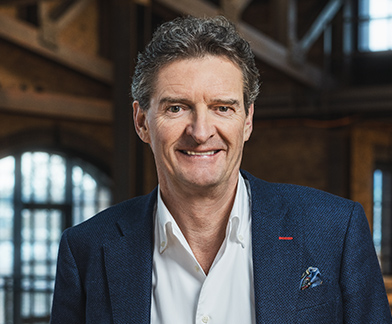 Image source: Partners Group
Urs Wietlisbach
Co-Founder and Member of the Board of Directors, Partners Group
Urs Wietlisbach co-founded Partners Group with Alfred Gantner and Marcel Erni in 1996. Before founding the firm, he worked at Goldman Sachs and Credit Suisse. He holds a master’s degree from the University of St. Gallen (HSG). He is also a co-founder and co-owner of Property One, Chairman of Blue Earth Capital and active in the Blue Earth Foundation. Together with his wife Simone, he established the Ursimone Wietlisbach Foundation, which supports health, education and sport.