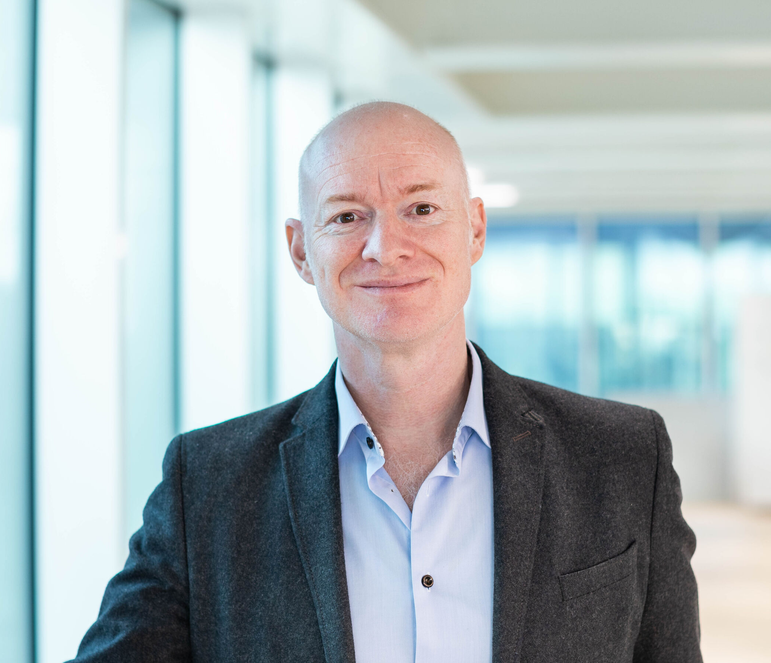


Disclaimer: This interview was conducted on the 8th of May
You grew up in Austria, were raised in Istanbul and Johannesburg, and began your career in Switzerland. How did this cross-cultural upbringing shape who you are as a leader today?
I owe my career to my upbringing. I got started in football while studying in Graz and was approached by T.E.A.M. Marketing, who were handling the Champions League. My home team, Sturm Graz, was in the Champions League at the time, and they were looking for student drivers. When they realized I spoke Turkish, I became responsible for servicing the Turkish broadcaster, where there were a lot of language issues. That is basically the coincidence that brought me into football.
The multicultural upbringing helped enormously, also working in Qatar, where I experienced first-hand how much we in Europe underestimate intercultural communication. In the Arab world, people want to get to know you and build trust before doing business. From a European perspective, sitting drinking tea without a visible agenda can feel unproductive, but if you do not build that trust relationship, you simply do not get started. I learned that flexibility and cultural awareness, the ability to use the back door when the front one is closed, are essential in a global world.
You started at T.E.A.M. Marketing AG in Switzerland before rising to COO of the largest World Cup in history. Looking back, was there a defining moment that set you on this path?
There was no single defining moment. You grow into everything, and that takes time. But what I would tie into this is how important it is to treat people well. The people you treat well on your way up, you will meet on your way down. The sports and mega-event world is a very small world; everyone knows each other, and your reputation and track record are everything. If you enjoy working with people and across cultures, you end up making friends all over the world, which is extremely rewarding.
For our readers who may be less familiar with your role, what does a typical week look like for the COO of the FIFA World Cup 2026?
There is no typical week, and that is part of the excitement. It involves a lot of travel, many meetings, and going to the places where events will be staged. Meeting people in person is something we really missed during COVID. Now, with roughly 30 days to go, it is mainly troubleshooting and managing relationships. I would say 90 percent of my day is communicating with colleagues, cities, and stakeholders, preferably in person.
The 2026 World Cup spans three countries, 16 cities, and 104 matches. How do you structure decision-making across such a complex, multi-stakeholder organization without losing operational precision?
The scale is a genuine challenge, 48 teams, 16 cities, three countries. We have gone from one extreme to the other compared with Qatar, where everything was purpose-built for the World Cup; here, we are working with existing stadiums, major airport infrastructure, and workforces already experienced in staging large events every week. The challenge is getting them to operate in a FIFA tournament way, this is not one standalone event in one city but one of 16 host cities all running simultaneously.
Our approach combines being hyper-local, with teams already embedded in each stadium and host city working alongside local stakeholders, and having a very centralized command-and-control structure. All venues report to our tournament operations center in Miami, where the leads of every functional area, transport, travel, venue management, competition, media, TV operations, and so on, sit together to make central decisions and ensure consistency. Whether a stakeholder is in Vancouver or Guadalajara, they should experience the same accreditation system and the same level of service.
The cross-functional nature of operations means one incident can cascade quickly. If a team is delayed at an airport because of a lightning storm, that affects transportation, the police escort to their base camp, late check-in at their accommodation, and meals on arrival. Having everyone, including the national weather service, in one room in Miami means we can plan and respond in real time
You described the 2026 World Cup as “the first FIFA World Cup fully under FIFA’s control.” What does that mean in practice, and what does it change about how the tournament is being delivered?
In previous tournaments, local organising committees, affiliated with governments and national football associations, delivered the event on FIFA’s behalf. The disadvantage was limited control and limited knowledge transfer. We used to say that an LOC at the end of a World Cup is finally at the level it should have been at the start of the project. By managing it directly, we retain know-how in-house, carry people across events, and exercise far greater control over our flagship tournaments. We apply the same model to the Women’s World Cup.
That said, every model has its pros and cons. In Qatar, for example, we had a joint venture with the Qataris that worked very well. You really need to assess what works on a case-by-case basis.
How is AI or data analytics actively changing the way FIFA plans and runs operations – from crowd flow and security to broadcast logistics?
AI touches almost every aspect of what we do. On the sporting side, football AI helps interpret the data we capture, and AI-enabled 3D player avatars are used to determine the virtual offside line, detecting whether a body part crosses it. On the broadcast side, as seen at the Club World Cup, the cameras mounted on referees are image-stabilized using AI. Operationally, we deploy interactive maps with smart wayfinding for spectators and other groups. And our tournament operations center features an AI cockpit that processes venue reports, produces executive summaries, and flags emerging trends. It does not replace experience or team communication, but it helps us filter an enormous volume of daily data. Technology partners such as Lenovo have been very active in supporting us on this front.
What is the long-term economic legacy for host cities like Dallas, Vancouver or Guadalajara, and how do you ensure that local communities actually benefit, rather than just bearing the cost?
The World Cup is a huge platform that brings attention and exposure, including prominent placement of city names on our central LED boards. But it is really down to each city to decide what legacy they want. It can be infrastructure investment, a boost to tourism, or urban regeneration. We have quite a few US cities using the World Cup to rejuvenate downtown areas affected by the homeless crisis and the opioid crisis, creating soccer pitches and fan fest zones there. We do not dictate what is best for a city. Instead, every host city has a committee that receives commercial rights from FIFA to monetize and fund its own legacy initiatives. Beyond that, the tournament creates hundreds of thousands of jobs and significant socio-economic impact through tourism, media exposure, and the visitors who will keep talking about those cities afterwards.
Together with host cities, we have various programs targeted at grassroots communities. One initiative involves working with a veteran organization to provide tickets to US service veterans.
Large-scale sporting events are often criticized for becoming less accessible to average fans due to pricing and hospitality packages. How do you think about the trade-off between maximising revenue and preserving the World Cup’s identity as a tournament for everyone?
It is a question we debate internally and one that is discussed very intensively in the media. We have always looked at accessible options: there is a $60 ticket, 1,000 per match, including the final, distributed through participating member associations to their fan clubs, who determine which real supporters should receive them. We also offer a range of more affordable tickets across the group stage.
At the same time, FIFA is a not-for-profit organization. All revenues are reinvested in football and redistributed to our 211 member associations for development initiatives globally, including the countries now participating thanks to the FIFA Forward program. We also have to be realistic about the secondary market, which is legal in the US. The tickets we put on the resale platform have an average face value of around $350 but sell for around $800 to $840. If we priced all tickets at $100 or $150, the majority would simply flow to the secondary market, benefiting resellers rather than global football.
There is also huge demand from many large European countries. The US is a prime holiday destination, easy to reach and easy to travel around. We also see strong demand from South America and parts of Asia. And it is worth remembering that virtually every country in the world is already represented within the United States. Iran is a good example, with such a large Iranian-American community, those matches are expected to feel like a genuine celebration and festival.
How do you think the demand for football will change in the United States in particular after the tournament?
After the 1994 World Cup, Major League Soccer was formed, there was no professional league before it. It is still hard to judge exactly what this tournament will mean long-term. I am not going to say football will become the number one sport in the US, but that is definitely the ambition. The number of children playing the game is staggering. In Miami, where I live, every pitch is full on weekends. What is made of the boost is up to US Soccer, MLS, and local community programs, but the boost itself will be significant. Inter Miami has already demonstrated that there is a real market and appetite for the sport globally.
Expanding to 48 teams fundamentally changes the commercial and operational calculus. What are the biggest business opportunities that come with scale and what are the risks that people underestimate?
The advantages are clear: the tournament is bigger, more inclusive, and generates more underdog stories, teams like Cabo Verde, Curaçao, Jordan, Uzbekistan. Surprises and upsets keep the narrative alive, give the media a great deal to write about, and make the event truly global. Working at FIFA, you quickly realize how big and diverse the world is, European football is important and powerful, but there is enormous passion and energy well beyond it. With 48 teams, we will see more of that than ever before.
The complexity does increase substantially, however. All 48 teams need base camps and supporting infrastructure, and we need all our stadiums to absorb the additional matches the expanded format generates.
You are coordinating thousands of staff, national governments, broadcasters, and sponsors simultaneously. What leadership principle do you fall back on when things get chaotic?
Thank God it is not actually chaotic, but you feel the pace accelerating. One principle that works for me: when people get hectic, I get calm; when people are too relaxed, I stir the pot. Being the counterweight to the general mood in the room is always my goal. If it is too peaceful, that is not good; if it is too frantic, that is not good either. We need equilibrium.
The other principles are clear priorities, clear communication, and clear instructions. My leadership style is inclusive, I have five to seven people whose opinions I deeply value, and decisions emerge from dialogue rather than isolation. And I always go to the source: sometimes that means talking to staff members three levels down in the hierarchy, because they often have the most direct knowledge of a situation.
Beyond the trophy and the final scorelines, what is the one thing you want the 2026 World Cup to be remembered for in 20 years?
I will go a bit highbrow here. These are uncertain and very divided times, across the world and across North America, people are split into political camps, and there is not much that unites them or gives them a break from their worries. If the World Cup can help bring people closer together, help them forget their differences and focus on what they share, the excitement of a match, time with friends and family, that would be a great thing.
Commercially, I am fairly confident this will be remembered as one of the most successful World Cups. And I hope for great football, as we saw in Qatar, with remarkable matches and a final people will never forget. We cannot control the performances on the pitch, but we create the best possible conditions: perfect surfaces, good training environments, and travel that is as smooth as possible. In the end, what people truly remember is what happens on the pitch.
Our readers are mostly students and young professionals building international careers. What is the single most important piece of advice you would give someone who wants to operate at the highest levels of global sports or business?
Go through the ranks. I started as a driver, then worked in venue management, TV graphics, and as a camera operator. I know many different facets of this business. The important thing is to get started, do not overthink it and do not fix yourself to one single career path. You study something to learn everything about that field, and then perhaps you do something entirely different. Seize the opportunities given to you and make the most of them; things grow organically from there.
There is a lot of luck involved, and I feel genuinely lucky to be where I am. It was not a linear dream I followed, it evolved through hard work, building relationships, and contributing wherever I was. I tried to be the best driver: cleanest car, on time, properly dressed. Step by step. Do not think about the end goal, focus on what you can do in the present moment.
Work hard, do not burn bridges, and pay attention to your environment, your colleagues, your fellow students. There is always something to learn, even from an internship that seems trivial. Sometimes the lesson is simply that you do not want to do that particular thing, and that is valuable too.